


Page 39 - e-book
P. 39
=kSekfld (f}Hkk"kh;) if=kdk  i`"B 37 | tuojh & ekpZ 2023  =kSekfld (f}Hkk"kh;) if=kdk


          rye (Secale cereale), oats (Avena sativa), barley
          (Hordeum  vulgare), abiding  ryegrass  (Lolium
          perenne), Italian  ryegrass (Lolium  multiflorum),
          buckwheat (Fagopyrum esculentum),  chicory
          (Chichorum intybus) may however, also be used
          as green manuring crops. These crops can also
          be grown as an intercrop, i.e., grown along the
          main  crop  and  before  reaching  the  flowering
          stage they are cut and buried into the soil and
          allowed to decompose.
          2.  Ex-situ  green   manuring/Green    leaf
          manuring

          Leguminous/non-leguminous  tree  species  may
          be cultivated on the boundaries of the field or on
          the bunds on the plots. Tree species considered
          are as follows: Subabul (Leucaena leucocephala),
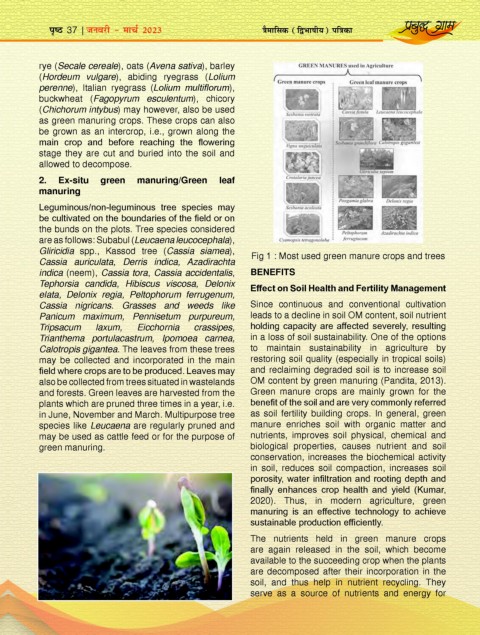
          Gliricidia  spp., Kassod tree (Cassia siamea),   Fig 1 : Most used green manure crops and trees
          Cassia  auriculata,  Derris indica,  Azadirachta
          indica (neem), Cassia tora, Cassia accidentalis,   BENEFITS
          Tephorsia candida, Hibiscus viscosa, Delonix   Effect on Soil Health and Fertility Management
          elata, Delonix  regia, Peltophorum ferrugenum,
          Cassia nigricans. Grasses and weeds like      Since continuous and conventional cultivation
          Panicum  maximum, Pennisetum purpureum,       leads to a decline in soil OM content, soil nutrient
          Tripsacum   laxum,   Eicchornia   crassipes,  holding capacity are affected severely, resulting
          Trianthema  portulacastrum, Ipomoea carnea,   in a loss of soil sustainability. One of the options
          Calotropis gigantea. The leaves from these trees   to maintain  sustainability  in agriculture  by
          may be collected  and incorporated  in the main   restoring soil quality (especially in tropical soils)
          field where crops are to be produced. Leaves may   and reclaiming degraded soil is to increase soil
          also be collected from trees situated in wastelands   OM content by green manuring (Pandita, 2013).
          and forests. Green leaves are harvested from the   Green manure crops are mainly  grown  for the
          plants which are pruned three times in a year, i.e.   benefit of the soil and are very commonly referred
          in June, November and March. Multipurpose tree   as soil fertility building crops. In general, green
          species like Leucaena are regularly pruned and   manure  enriches  soil with organic  matter and
          may be used as cattle feed or for the purpose of   nutrients, improves soil physical, chemical and
          green manuring.                               biological  properties, causes nutrient  and  soil
                                                        conservation, increases the biochemical activity
                                                        in soil, reduces  soil compaction, increases soil
                                                        porosity, water infiltration and rooting depth and
                                                        finally  enhances  crop  health  and  yield  (Kumar,
                                                        2020).  Thus,  in modern agriculture, green
                                                        manuring  is  an  effective  technology  to  achieve
                                                        sustainable production efficiently.
                                                        The  nutrients held in green manure crops
                                                        are again released in the  soil, which become
                                                        available to the succeeding crop when the plants
                                                        are decomposed after their incorporation in the
                                                        soil, and thus help  in nutrient recycling.  They
                                                        serve as a source of nutrients and  energy  for

